
Medium
Etching and drypoint
Dimensions
Sheet: 8 11/16 × 6 13/16 in. (22 × 17.3 cm) Plate: 6 7/8 × 5 9/16 in. (17.5 × 14.1 cm)
Classification
Prints
Department
Drawings and Prints
Museum
Metropolitan Museum of Art, New York, NY
Credit
The Elisha Whittelsey Collection, The Elisha Whittelsey Fund, 1959
Accession Number
59.500.781
Rights
Public Domain
Tags
Art Historical Context
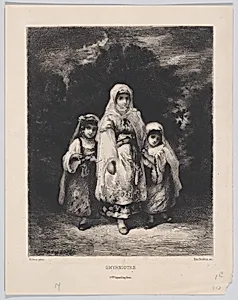
**Smyrniotes** (1873) is a delicate etching and drypoint print through a collaboration between French artist Narcisse-Virgile Diaz de la Peña, known for his Romantic landscapes and figure studies influenced by the Barbizon School and printers Emile Boilvin and Françoisénard. Housed in the Metropolitan Museum of Art's Drawings and Prints department from The Elisha Whittelsey Collection, this work (plate: 6 7/8 × 5 9/16 in.) captures Smyrniotes—residents of Smyrna (modern-day Izmir, Turkey)—likely on children, as suggested by its tagging. Diaz's evocative designs brought an exotic, Orientalist flair to 19th-century European art, romanticizing Eastern subjects amid France's growing fascination with Levantine cultures. The medium shines here: etching uses acid to incise precise lines into a metal plate for rich tonal depth, while drypoint adds soft, velvety burrs from direct needle scratches, lending a painterly texture ideal for tender portraits. This technique allowed affordable reproduction of Diaz's oil-inspired visions, bridging fine art and printmaking during a print boom. Printed in 1873, amid post-Napoleonic travels and Ottoman-European exchanges, **Smyrniotes** reflects Orientalism's allure—exotic attire, youthful innocence—offering visitors a window into a cosmopolitan port city's vibrancy, preserved through masterful craftsmanship.
About the Artist
Emile Boilvin|François Liénard|Narcisse-Virgile Diaz de la Peña · 1845–1899
Comment on works: painter; etcher