
Snare Drum
Unknown Artist
mid to late 19th century
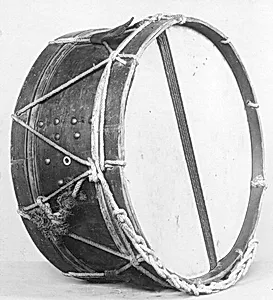
Medium
Wood, skin, rope
Dimensions
H. ca. 20.2 cm (7-15/16 in.), Diam. at widest ca. 41 cm (16-1/8 in.); Diam. of heads ca. 38.8 cm (15-5/16 in.)
Classification
Membranophone-double-headed / cylindrical drum
Culture
American
Department
Musical Instruments
Museum
Metropolitan Museum of Art, New York, NY
Credit
The Crosby Brown Collection of Musical Instruments, 1889
Accession Number
89.4.590
Rights
Public Domain
Art Historical Context
This unassuming yet vital snare drum, crafted by an unknown American maker in the mid- to late 19th, exemplifies the sturdy craftsmanship of period percussion instruments. Fashioned from wood for its cylindrical body, animal skin for the taut drumheads (measuring about 15-5/16 inches in diameter), and rope foring, it stands roughly 8 inches tall with a widest diameter of 161/8 inches. As a double-headed membranophone, it produces its signature crisp, rattling sound when struck, with snares likely stretched beneath one head to vibrate against it—a technique honed for projection in open-air settings. Housed in the Metropolitan Museum of Art's Musical Instruments Department as part of the renowned Crosby Brown Collection (acquired in 1889), this drum offers a tangible link to 19th-century American musical life. During an era of rapid industrialization, Civil War marches, and burgeoning brass bands, snare drums like this one provided rhythmic backbone for military parades, civic events, and community gatherings, embodying the democratic spirit of participatory music-making. Its simple materials highlight resourceful vernacular artistry, where functionality met acoustic precision. Visitors, imagine the thunderous rolls echoing across battlefields or town squares— a humble object that pulsed with the heartbeat of a young nation.