
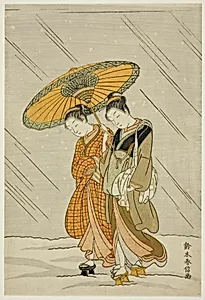
Snow on the Way Back from the Public Bath
c. 1766/67
Medium
Color woodblock print; chuban
Dimensions
27.8 × 18.8 cm (11 × 8 1/4 in.)
Classification
woodblock print
Department
Arts of Asia
Museum
Art Institute of Chicago
Accession Number
77302
Rights
Public Domain
Art Historical Context
Suzuki Harunobu's *Snow on the Way Back the Public Bath* (c. 1766/67) captures a serene winter moment in Edo-period Japan (modern-day Tokyo), where women hurry home from the communal bathhouse amid falling snow. As a master of ukiyo-e "pictures of the floating world" genre celebrating everyday pleasures, beauty, and urban life—Harunobu pioneered full-color woodblock prints, known as *nishiki-e* or "brocade pictures," around 1765. This brought vibrant hues and subtle gradations to affordable mass-produced art, making it accessible beyond the elite. Printed in the chuban format (a compact 27.8 × 18.8 cm, ideal for albums or collections), the work showcases Harunobu's mastery of layered woodblocks, where separate blocks for each color were meticulously carved and inked. Delicate whites evoke fresh snow, while contrasts in clothing and lanterns highlight the women's graceful poise on slippery paths—a nod to the cultural ritual of public bathing (*sento*), a social cornerstone for women in 18th-century Japan. Housed in the Art Institute of Chicago's Arts of Asia department, this print exemplifies Harunobu's influence on later ukiyo-e giants like Hiroshige and Utamaro, blending lyricism with realism to immortalize fleeting beauty. Visitors, imagine the chill and chatter echoing through snowy streets!
About the Artist
Suzuki Harunobu · 1725–1770
Suzuki Harunobu (c. 1725-1770) was a Japanese ukiyo-e artist who revolutionized woodblock printing by developing nishiki-e—full-color prints using multiple woodblocks—in 1765. Before Harunobu, Japanese prints were limited to two or three colors; his innovation unleashed the entire artist's palette, transforming ukiyo-e into the vibrant art form that would later captivate Western artists from Manet...