
Snuff Bottle
Unknown Artist
Medium
Porcelain
Dimensions
H. 2 3/4 in. (7 cm)
Classification
Snuff Bottles
Culture & Period
China · Qing dynasty (1644–1911), Qianlong period (1736–95)
Department
Asian Art
Museum
Metropolitan Museum of Art, New York, NY
Credit
Bequest of Benjamin Altman, 1913
Accession Number
14.40.564a, b
Rights
Public Domain
Tags
Art Historical Context
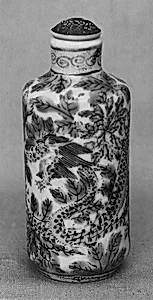
This exquisite porcelain snuff bottle hails from China's Qing dynasty during the Qianlong period (1736–95), a golden age of imperial artistry and porcelain production at the famed Jingdezhen kilns. Standing just 2 3/4 inches (7 cm) tall, these diminutive vessels were designed to hold powdered tobacco snuff, introduced to China by European Jesuits in the 17th century. By the Qianlong era, snuff-taking had become a refined pastime among scholars, officials, and the elite, transforming these bottles into coveted status symbols often carried in sleeves or pockets. Crafted from fine porcelain, the bottle exemplifies the technical mastery of Qing potters, who achieved translucent glazes and intricate designs on such a tiny scale. Dragons, a recurring motif symbolizing imperial power, protection, and good fortune, likely adorn its surface—evoking the emperor's own fascination with these mythical creatures. Such bottles were not mere containers but miniature masterpieces, blending functionality with artistry. A generous bequest from Benjamin Altman in 1913 brought this treasure to The Metropolitan Museum of Art's Asian Art collection, where it invites visitors to ponder the cross-cultural exchanges and opulent tastes of 18th-century China. (198 words)