
Snuff Bottle
Unknown Artist
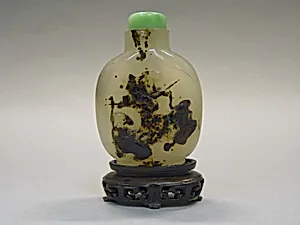
Medium
Murrhina agate with green jadeite stopper
Dimensions
H. 2 3/4 in. (7 cm)
Classification
Snuff Bottles
Culture & Period
China · Qing dynasty (1644–1911), Qianlong period (1736–95)
Department
Asian Art
Museum
Metropolitan Museum of Art, New York, NY
Credit
Bequest of Edmund C. Converse, 1921
Accession Number
21.175.153a, b
Rights
Public Domain
Art Historical Context
This exquisite snuff bottle, crafted during China's Qing dynasty Qianlong period (1736–95), exemplifies the era's masterful lapidary arts. Snuff bottles like this one were portable luxury containers for finely ground tobacco, introduced by European traders in the 17th century and elevated to status symbols among the elite. The Qianlong emperor himself amassed thousands, commissioning works from rare stones to showcase imperial refinement. Measuring just 2¾ inches tall, its compact form made it ideal for wearing on a chain or tucking into a sleeve. Carved from murrhina agate—a prized banded stone with intricate natural veining that artists skillfully revealed through precise cutting and polishing—the bottle's translucent layers create mesmerizing patterns evoking misty landscapes or flowing clouds. The vibrant green jadeite stopper, a gem revered in Chinese culture for its purity and imperial associations, adds a harmonious contrast and functional seal. Such techniques highlighted the connoisseurship of Qing artisans, transforming raw minerals into poetic objects. Bequeathed to the Metropolitan Museum of Art in 1921, this bottle reflects the global allure of Chinese decorative arts, blending utility with breathtaking natural beauty. Visitors, imagine the soft click of the stopper as a Qing scholar savored a pinch of snuff amid scholarly pursuits!