
Snuff Bottle
Unknown Artist
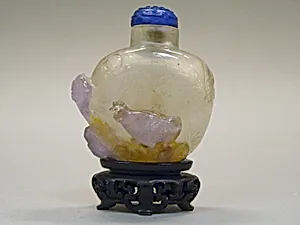
Medium
Crystal and amethyst with blue glass stopper
Dimensions
H. 2 1/2 in. (6.4 cm)
Classification
Snuff Bottles
Culture & Period
China · Qing dynasty (1644–1911), Qianlong period (1736–95)
Department
Asian Art
Museum
Metropolitan Museum of Art, New York, NY
Credit
Bequest of Edmund C. Converse, 1921
Accession Number
21.175.164a, b
Rights
Public Domain
Tags
Art Historical Context
This exquisite snuff bottle, crafted during China's Qing dynasty Qianlong period (1736–95), exemplifies the refined artistry of imperial workshops. Snuff bottles like this one were portable luxury containers for finely ground tobacco, introduced to China by Europeans in the 17th century. They became status symbols among the elite, including the Qianlong emperor himself, who amassed vast collections. At just 2½ inches tall, its compact size made it ideal for tucking into a sleeve, blending functionality with opulent design. Made of clear crystal and vibrant amethyst with a blue glass stopper, the bottle showcases masterful lapidary techniques. Artisans likely carved intricate motifs—here, playful chickens—directly into the stone, a hallmark of Qing jade and glasswork adapted to hardstones. Chickens, auspicious symbols in Chinese culture for diligence and prosperity, add layered meaning, evoking wishes for good fortune. Housed in the Metropolitan Museum of Art's Asian Art Department (bequest of Edmund C. Converse, 1921), this anonymous masterpiece highlights the Qianlong era's pinnacle of decorative arts, where everyday objects transcended utility to become miniature sculptures of imperial elegance.