
Snuff Bottle
Unknown Artist
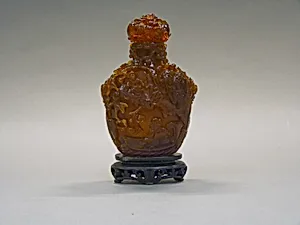
Medium
Amber
Dimensions
H. 3 1/2 in. (8.9 cm)
Classification
Snuff Bottles
Culture & Period
China · Qing dynasty (1644–1911), Qianlong period (1736–95)
Department
Asian Art
Museum
Metropolitan Museum of Art, New York, NY
Credit
Bequest of Edmund C. Converse, 1921
Accession Number
21.175.202a, b
Rights
Public Domain
Tags
Art Historical Context
This exquisite amber snuff bottle, hailing from China's Qing dynasty during the Qianlong period (6–95), exemplifies refined artistry of imperial-era craftsmanship. Snuff bottles like this one were portable containers for powdered tobacco, a luxury introduced by European traders in the 17th century They became status symbols among Qing scholars, officials, and the emperor himself, who amassed vast collections. Crafted during Qianlong's reign—a golden age of artistic patronage—this pocket-sized gem (just 3½ inches tall) reflects the era's obsession with miniaturist perfection and natural materials. Carved from lustrous amber, a rare and precious medium prized for its warm, translucent glow, the bottle likely features intricate scenes of human figures and boats, evoking lively riverine life along China's waterways. Amber's softness demanded masterful techniques to avoid cracking, resulting in delicate relief carvings that capture movement and narrative in miniature. Such bottles were not mere utilitarian objects but connoisseur pieces, often appreciated through a magnifying glass for their technical virtuosity. Now in the Metropolitan Museum of Art's Asian Art collection, thanks to the 1921 bequest of Edmund C. Converse, this anonymous masterpiece invites us to ponder the blend of everyday ritual and elite culture in 18th-century China.