
Snuff Bottle
Unknown Artist
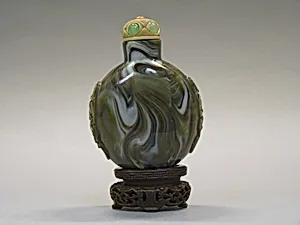
Medium
Gray glass with ivory stopper inlaid with stones
Dimensions
H. 3 1/8 in. (7.9 cm)
Classification
Snuff Bottles
Culture & Period
China · Qing dynasty (1644–1911), Qianlong period (1736–95)
Department
Asian Art
Museum
Metropolitan Museum of Art, New York, NY
Credit
Bequest of Edmund C. Converse, 1921
Accession Number
21.175.216a, b
Rights
Public Domain
Art Historical Context
This delicate snuff bottle hails from China's Qing dynasty during the Qianlong period (6–95), a era of imperial patronage for the arts. Snuff bottles like this one were portable containers for finely powdered tobacco, introduced by European traders in the 17th century Fashioned as miniature masterpieces, they became coveted status symbols among scholars, officials, and the elite, often worn on chains or carried in sleeves for discreet use. Crafted from translucent gray glass—a material prized for its clarity and versatility in imperial workshops—the bottle stands just 3 1/8 inches tall, perfect for personal adornment. Its elegant ivory stopper, inlaid with colorful stones, adds a touch of opulence, showcasing the intricate craftsmanship of the era. Glass snuff bottles were sometimes molded, engraved, or painted inside, highlighting the technical prowess of Qing artisans who rivaled jade and porcelain in finesse. Housed in the Metropolitan Museum of Art's Asian Art Department through the 1921 bequest of collector Edmund C. Converse, this anonymous gem reflects the refined aesthetics and cultural fusion of 18th-century China, blending everyday utility with artistic splendor.