
Snuff Bottle
Unknown Artist
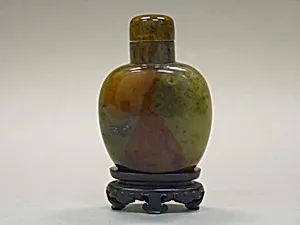
Medium
Moss agate
Dimensions
H. 2 3/4 in. (7 cm)
Classification
Snuff Bottles
Culture & Period
China · Qing dynasty (1644–1911), Qianlong period (1736–95)
Department
Asian Art
Museum
Metropolitan Museum of Art, New York, NY
Credit
Bequest of Edmund C. Converse, 1921
Accession Number
21.175.232a, b
Rights
Public Domain
Art Historical Context
This delicate snuff bottle, fashioned from moss agate during the Qianlong period (1736–95) of China's Qing dynasty (1644–1911), captures the era's obsession with refined luxury. Standing just 2 3/4 inches (7 cm) tall, it served as a portable container for powdered tobacco snuff, a habit introduced from Europe and embraced by the imperial elite. The Qianlong emperor himself was a avid collector, fostering workshops that elevated these diminutive objects into high art. Moss agate, a semi-precious chalcedony variety, features natural, moss-like inclusions that create ethereal, landscape-like patterns within its translucent body. Artisans often left such stones largely uncarved to celebrate their organic beauty, showcasing the Qing mastery of material selection over overt intervention. This technique highlighted the harmony between nature and human craft, a core tenet of Chinese aesthetics. Housed in the Metropolitan Museum of Art's Asian Art Department through the 1921 bequest of Edmund C. Converse, the bottle reflects snuff bottles' role as status symbols and conversation pieces among scholars and officials. It offers a window into 18th-century China's cosmopolitan tastes, blending tradition with exotic imports.