
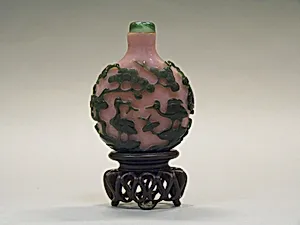
Snuff Bottle
Unknown Artist
Medium
Peking glass
Dimensions
H. 2 7/8 in. (7.3 cm)
Classification
Snuff Bottles
Culture & Period
China · Qing dynasty (1644–1911), Qianlong period (1736–95)
Department
Asian Art
Museum
Metropolitan Museum of Art, New York, NY
Credit
Bequest of Edmund C. Converse, 1921
Accession Number
21.175.308a, b
Rights
Public Domain
Tags
Art Historical Context
This exquisite snuff bottle, crafted from Peking glass during the Qianlong period (1736–95) of China's Qing dynasty (16441911), exemplifies the era's masterful blend of artistry and luxury. Standing just 2 7/8 inches tall, its petite form was designed for portability, allowing elites to carry finely ground tobacco snuff—a habit introduced by Europeans and enthusiastically adopted by Manchu emperors. Peking glass, produced in Beijing workshops, mimicked the prized translucency of jade or porcelain through innovative layering and molding techniques, often yielding vibrant colors and intricate motifs like birds, symbolizing grace and good fortune in Chinese culture. Snuff bottles like this one were more than utilitarian objects; they became coveted collectibles among scholars, officials, and the imperial court, showcasing the Qianlong emperor's patronage of refined crafts. The unknown artist's skill in capturing delicate details highlights the period's technical prowess, where glass was blown, cut, and engraved to create optical illusions and depth. Housed in the Metropolitan Museum of Art's Asian Art department through the 1921 bequest of Edmund C. Converse, this bottle offers a window into Qing opulence, inviting us to appreciate how everyday indulgences evolved into high art.