
Snuff Bottle
Unknown Artist
19th century
Medium
Painted enamel
Dimensions
H. 2 1/4 in. (5.7 cm)
Classification
Snuff Bottles
Culture & Period
China · Qing dynasty (1644–1911)
Department
Asian Art
Museum
Metropolitan Museum of Art, New York, NY
Credit
Bequest of Mary Stillman Harkness, 1950
Accession Number
50.145.175a, b
Rights
Public Domain
Tags
Art Historical Context
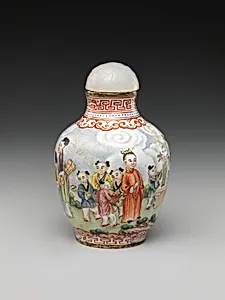
This delicate snuff bottle, created in 19th-century China during the Qing dynasty, reflects the era’s refined taste for portable luxury objects. Snuff tobacco, introduced to China through European trade in the late 17th century, quickly became fashionable among the elite. Small bottles like this one, measuring just over two inches tall, were designed to hold powdered tobacco and were often carried in sleeves or hung from belts as both functional items and status symbols. Crafted in painted enamel, the bottle showcases a technique that combined Chinese porcelain traditions with European enamel methods introduced by Jesuit missionaries. The medium allowed artists to apply vibrant, durable colors in intricate designs on a miniature scale. The presence of human figures and children among its decorations suggests lively narrative scenes, possibly drawn from daily life or auspicious motifs popular during the Qing period, turning the object into a miniature canvas of cultural storytelling. Acquired by the Metropolitan Museum through the bequest of Mary Stillman Harkness in 1950, this work exemplifies how Qing artisans elevated everyday accessories into exquisite works of art. Its compact form and detailed enamelwork highlight the dynasty’s emphasis on technical mastery and aesthetic refinement in even the smallest creations.