
Snuffbox
ca. 1735–40
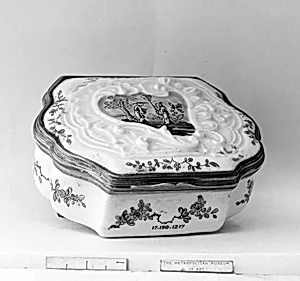
Medium
Soft-paste porcelain, silvered copper
Dimensions
3 3/16 × 2 5/8 in. (8.1 × 6.7 cm)
Classification
Ceramics-Porcelain
Culture
French, Saint-Cloud
Department
European Sculpture and Decorative Arts
Museum
Metropolitan Museum of Art, New York, NY
Credit
Gift of J. Pierpont Morgan, 1917
Accession Number
17.190.1217
Rights
Public Domain
Tags
Art Historical Context
This exquisite snuffbox, crafted by the renowned Saint-Cloud factory around 1735–40, exemplifies the pinnacle of early French porcelain artistry. Measuring just 3 3/16 × 2 5/8 inches, this pocket-sized luxury item is made from soft-paste porcelain—a French innovation that mimicked costly Chinese hard-paste porcelain before its local mastery—with a gleaming silvered copper mount. in Saint-Cloud near Paris, it reflects the factory's expertise in delicate, translucent wares during the opulent reign of Louis XV. Snuffboxes like this were essential accessories for the 18th-century aristocracy, who indulged in finely ground tobacco as a fashionable social ritual. The Saint-Cloud factory, active from the late 17th century, played a key role in France's porcelain revolution, producing high-quality soft-paste pieces often decorated with vibrant enamels. This example features charming motifs of men amid flowers and trees, evoking pastoral scenes that capture the Rococo era's delight in nature and leisure. A gift to the Metropolitan Museum of Art from J. Pierpont Morgan in 1917, this snuffbox highlights the cultural prestige of European decorative arts. Its diminutive scale belies its technical sophistication, inviting visitors to marvel at the era's blend of functionality and extravagance.
About the Artist
Saint-Cloud factory · 1693–1766
The Saint-Cloud porcelain factory, situated on the Seine in the town of Saint-Cloud near Paris, revolutionized European ceramics as the first to manufacture soft-paste porcelain commercially, beginning in 1693. Originally established around 1664-1666 as a faience workshop, it shifted to porcelain under Pierre Chicaneau, a potter whose experiments yielded a frit-based paste with a warm yellowish or...