
Snuffbox
Unknown Artist
1774–75
Medium
Varicolored gold
Dimensions
1 3/16 × 2 × 2 7/8 in. (3 × 5.1 × 7.3 cm)
Classification
Metalwork-Gold and Platinum
Culture
French, Paris
Department
European Sculpture and Decorative Arts
Museum
Metropolitan Museum of Art, New York, NY
Credit
Gift of Mrs. Samuel I. Rosenman, 1970
Accession Number
1970.308.1
Rights
Public Domain
Tags
Art Historical Context
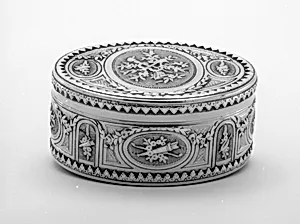
This exquisite snuffbox, crafted in Paris between 1774 and 1775, exemplifies the refined luxury of late eighteenth-century French decorative arts. Made from varicolored gold, the piece achieves its subtle hues through the careful alloying of gold with other metals—such as copper for warm tones and silver for cooler shades—creating a rich, painterly surface without the use of enamel or additional materials. Its compact size, just over two inches wide, made it ideal for carrying in a pocket or reticule, reflecting the era’s fashionable rituals of snuff-taking among the aristocracy. Produced during the early years of Louis XVI’s reign, the box captures a transitional moment between the playful curves of Rococo and the emerging restraint of Neoclassicism. Paris remained Europe’s foremost center for goldsmithing, where such objects served as both personal accessories and status symbols. The presence of bow-and-arrow motifs hints at themes of love or hunting popular in period ornament, rendered with the meticulous chasing and engraving typical of the city’s finest workshops. Donated to the Metropolitan Museum in 1970, this small masterpiece invites us to appreciate the extraordinary skill invested in even the most intimate objects of daily life.