
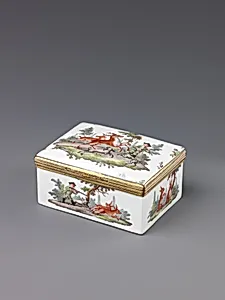
Snuffbox with Hunting Scenes
mid-late 18th century
Medium
Hard paste porcelain, copper-gilt mounts
Dimensions
H. 4.1 cm, L. 8.3 cm, D. 6.2 cm
Classification
Snuffboxes
Department
Robert Lehman Collection
Museum
Metropolitan Museum of Art, New York, NY
Credit
Robert Lehman Collection, 1975
Accession Number
1975.1.1547
Rights
Public Domain
Tags
Art Historical Context
This exquisite snuffbox, crafted by Philipp Oettner in mid-to-late 18th century, the opulence of European porcelain art during the Rococo era. Made from hard paste porcelain—a technical marvel that rivaled Chinese imports—with lavish copper-gilt mounts, measures a dainty 4.1 cm high, 8.3 cm long, and 6.2 cm deep, perfect for slipping into a gentleman's pocket. Oett, a skilled enameler likely associated with a Continental porcelain manufactory, painted vibrant hunting scenes featuring men, women, deer, and dogs, capturing the thrill of the chase in intricate detail. Snuffboxes like this were status symbols for the aristocracy, who indulged in finely ground tobacco snuff as a fashionable social ritual. The hunting motifs reflect the era's romanticized view of noble pursuits, blending leisure with displays of virility and equestrian prowess. The porcelain's translucent quality and fired enamel colors allowed for lifelike figures and dynamic compositions, showcasing advanced techniques in overglaze painting and gilding that highlighted the object's luxury. Part of the Robert Lehman Collection at The Metropolitan Museum of Art (1975), this piece invites visitors to ponder the refined tastes of 18th-century elites, where even everyday indulgences became miniature masterpieces of artistry and culture.