
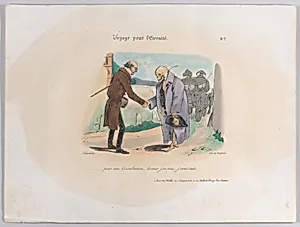
"So there was no noise in Paris?"
ca. 1830
Medium
Lithograph
Dimensions
Sheet: 8 1/8 × 9 5/8 in. (20.6 × 24.4 cm)
Classification
Prints
Department
Drawings and Prints
Museum
Metropolitan Museum of Art, New York, NY
Credit
The Elisha Whittelsey Collection. The Elisha Whittelsey Fund, 1958
Accession Number
58.512.22
Rights
Public Domain
Art Historical Context
In the turbulent wake of France's July Revolution of 1830, which toppled the Bourbon monarchy and ushered in the July Monarchy, French caricaturist J.. Grandville (Jeangnace-Isidore, 1803–1847), often collaborating with artist Langlumé, produced this lithograph titled *"So there was no noise in Paris?"*. Grandville was a pioneer of satirical illustration, renowned for his anthropomorphic animals and sharp social commentary that critiqued politics, fashion, and human folly. This work, likely poking fun at the eerie calm following revolutionary uproar or the regime's fragile stability, exemplifies his witty, exaggerated style that captivated 19th-century audiences. Printed as a lithograph—a revolutionary medium invented in 1798 that allowed artists like Grandville to draw directly on stone for affordable, high-quality reproductions—this 8 1/8 × 9 5/8 in. sheet belongs to the Metropolitan Museum of Art's Elisha Whittelsey Collection. Lithography democratized satire, enabling rapid dissemination of political humor amid Paris's vibrant print culture. Grandville's mastery of the technique brought fluid lines and dramatic contrasts, making his critiques both visually arresting and culturally resonant. Today, this piece offers a window into the era's revolutionary fervor and the power of visual satire to question authority with a sly question mark.