
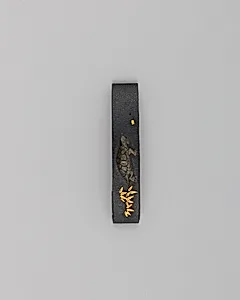
Socket Brace for Knife (Uragawara)
Unknown Artist
19th century
Medium
Copper-gold alloy (shakudō), copper-silver alloy (shibuichi), gold
Dimensions
H. 1 5/16 in. (3.3 cm); Wt. 0.2 oz. (5.7 g)
Classification
Sword Furniture
Culture
Japanese
Department
Arms and Armor
Museum
Metropolitan Museum of Art, New York, NY
Credit
Gift of a Trustee of the Museum, 1917
Accession Number
17.208.79
Rights
Public Domain
Tags
Art Historical Context
This elegant socket brace for a knife, known as an *uragawara*, dates to 19th-century Japan and forms part of the intricate fittings that adorned samurai swords and daggers. Measuring just over an inch in height, the showcases the refined metalworking traditions of the Edo and early Meiji periods, when even functional components of weaponry were elevated to objects of beauty. Crafted from shakudō (a copper-gold alloy), shibuichi (copper-silver), and gold, it exemplifies the sophisticated alloy techniques developed by Japanese artisans to achieve rich, contrasting colors through controlled patination. The use of these metals allowed craftsmen to create subtle tonal variations—deep blacks, soft grays, and warm golds—often enhanced with delicate inlays or engravings. Here, turtle motifs add a layer of symbolic meaning, as turtles have long represented longevity, wisdom, and good fortune in Japanese culture. Such small fittings, though hidden when the blade was sheathed, reflected the owner’s status and appreciation for art. As part of the Metropolitan Museum’s Arms and Armor collection, this *uragawara* highlights how Japanese sword furniture blended utility with aesthetic refinement, turning everyday martial equipment into miniature masterpieces.