
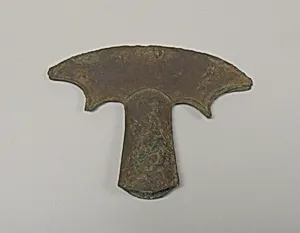
Socketed Ax
Unknown Artist
500 BCE–300 CE
Medium
Bronze
Dimensions
H. 5 3/8 in. (13.7 cm); W. 7 in. (17.8 cm); D. 7/8 in. (2.2 cm)
Classification
Metalwork
Culture & Period
Thailand · Bronze and Iron Age period
Department
Asian Art
Museum
Metropolitan Museum of Art, New York, NY
Credit
Samuel Eilenberg Collection, Bequest of Samuel Eilenberg, 1998
Accession Number
2001.433.149
Rights
Public Domain
Art Historical Context
This socketed ax, crafted in bronze around 500 BCE to 300 CE during Thailand's Bronze and Iron Age exemplifies the remarkable metalworking prowess of ancient Southeast Asian cultures. Measuring just 5⅜ inches high and 7 inches wide its compact yet robust form features a distinctive socket—a hollow tube at the base designed to securely fit a wooden handle, making it ideal for both practical use as a tool and as a weapon in daily life or warfare. Unearthed from the region's rich archaeological sites, such artifacts highlight Thailand's early mastery of bronze casting, a technique that involved pouring molten alloy into molds to create durable, functional objects. The ax's significance lies in its reflection of technological and cultural transitions during a pivotal era when bronze tools bridged stone-age traditions and emerging iron technologies. In ancient Thai societies, these implements were essential for agriculture, hunting, and ritual practices, often symbolizing status or communal strength. The smooth, patinated surface speaks to skilled lost-wax or piece-mold casting methods, showcasing aesthetic restraint alongside utility—prized qualities in utilitarian art. Now part of the Metropolitan Museum of Art's Asian Art collection, thanks to the Samuel Eilenberg Bequest of 1998, this ax invites visitors to ponder the ingenuity of Thailand's prehistoric innovators, whose handiwork laid foundations for enduring metallurgical legacies.