
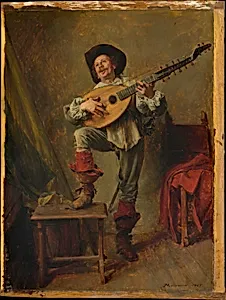
Soldier Playing the Theorbo
Medium
Oil on wood
Dimensions
11 1/2 x 8 5/8 in. (29.2 x 21.9 cm)
Classification
Paintings
Department
European Paintings
Museum
Metropolitan Museum of Art, New York, NY
Credit
Bequest of Martha T. Fiske Collord, in memory of her first husband, Josiah M. Fiske, 1908
Accession Number
08.136.7
Rights
Public Domain
Tags
Art Historical Context
Step into the intimate world of Ernest Meisson *Soldier Playing the Theor* (1865), a gem of European painting at The Metropolitan Museum of Art. petite oil on wood panel, measuring just 11½ x 8⅝ inches, captures a lone soldier in a moment of quiet reflection, strumming the theorbo—a large, lute-like string instrument popular in the Baroque era. Meissonier, a master of French Realism, renders the scene with astonishing precision, transforming a simple genre subject into a vivid tableau of human emotion amid martial life. Meissonier's signature style shines here: hyper-detailed brushwork that rivals miniature painting, with every crease in the soldier's uniform, glint of light on the theorbo's strings, and subtle texture of wood grain rendered in exquisite clarity. Painting on wood allowed for this jewel-like finish, emphasizing his fascination with 17th- and 18th-century military motifs, evoking the grandeur of historical campaigns while humanizing the soldier through music. Created during a time when France grappled with its Napoleonic legacy, this work highlights the cultural interplay of war and art. The theorbo, once essential for opera accompaniment, adds poetic irony—a warrior finding solace in melody. Donated in 1908, it invites visitors to ponder the tender side of soldiery, blending technical virtuosity with timeless resonance.