
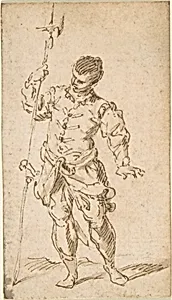
Soldier with Halberd
Medium
Pen and brown ink, brush and brown wash
Dimensions
3 5/16 x 1 7/8 in. (8.4 x 4.7 cm)
Classification
Drawings
Department
Drawings and Prints
Museum
Metropolitan Museum of Art, New York, NY
Credit
The Elisha Whittelsey Collection, The Elisha Whittelsey Fund, 1950
Accession Number
50.605.45
Rights
Public Domain
Tags
Art Historical Context
In the intimate world of 18th-century French drawings, *Soldier with Halberd* a poised figure in meticulous detail. Attributed to Claude Gillot an anonymous French artist of the period, this undated work measures just 3 5/16 x 1 7/8 inches, suggesting it was a preparatory study or collector's sketch rather than a finished piece. Housed in the Metropolitan Museum of Art's Drawings and Prints department, it exemplifies the era's fascination with military motifs, evoking the grandeur of soldiers amid France's turbulent history of wars and royal pageantry. Rendered in pen and brown ink with brush and brown wash, the technique highlights the artist's mastery of line and subtle tonal modeling. The fine ink strokes define the soldier's armor and the distinctive halberd—a polearm weapon combining axe and spear—while the wash adds depth and shadow, creating a sense of volume in this miniature format. Such methods were common in academic training and genre scenes, allowing artists like Gillot, a precursor to Rococo masters, to explore form and expression with economy. This drawing invites visitors to appreciate the artistry behind historical icons, reminding us how everyday sketches preserved the valor and weaponry of bygone eras for future generations.
About the Artist
Claude Gillot|Anonymous, French, 18th century · 1673–1722
Artist known for his elegant designs done in the Rococo manner of Audran; also for his predilection for scenes from the 'comedia dell'arte.' Few paintings survive; his work is known mainly through drawings and etchings. Comment on works: Genre; History