
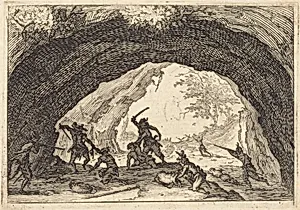
Soldiers Attacking Robbers
c. 1617
Medium
etching on laid paper
Dimensions
plate: 5.5 × 8 cm (2 3/16 × 3 1/8 in.) sheet: 6.4 × 9 cm (2 1/2 × 3 9/16 in.)
Classification
Department
CG-E
Museum
National Gallery of Art, Washington, D.C.
Credit
Rosenwald Collection
Accession Number
1949.5.104
Rights
Public Domain
Art Historical Context
In the early 17th century, French printmaker Jacques Callot captured the raw energy of conflict in *Soldiers Attacking Robbers* (c. 1617), a remarkably detailed etching on laid paper measuring just 5.5 × 8 cm. Working primarily in Florence for the Medici court during this period, Callot produced intimate scenes like this one, blending Baroque drama with sharp social observation. The print likely draws from the turbulent world of mercenaries and outlaws in post-Reformation Europe, where soldiers often clashed with bandits amid widespread instability. Callot's mastery of etching shines in this miniature format, using fine needles to incise intricate lines on a copper plate, then inking and printing to achieve extraordinary depth and texture. His innovative cross-hatching and swelling lines create a dynamic composition of thrusting spears, tumbling figures, and chaotic motion, all within a space smaller than a modern postcard. This technique allowed for affordable, reproducible art that reached wide audiences, influencing later printmakers like Goya. Housed in the National Gallery of Art's Rosenwald Collection (Department CG-E), this print exemplifies Callot's early prowess before his famous war series. It invites visitors to marvel at how such tiny details evoke the violence and vitality of 17th-century life—proof that great art thrives in small packages.
About the Artist
Jacques Callot · 1592–1635
Jacques Callot (1592–1635) was a French printmaker and draftsman from the Duchy of Lorraine, widely regarded as one of the first great artists to practice the graphic arts exclusively. His more than 1,400 etchings chronicled the breadth of 17th-century life, from Medici court festivities to the brutal realities of warfare. Callot revolutionized etching through technical innovations including the é...