
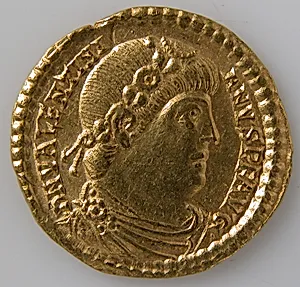
Solidus of Valentinian I (r. 364–375)
Unknown Artist
364–75
Medium
Gold
Dimensions
Overall: 13/16 x 1/16 in. (2 x 0.1 cm)
Classification
Coins
Culture
Byzantine
Department
Medieval Art
Museum
Metropolitan Museum of Art, New York, NY
Credit
Gift of C. Ruxton Love Jr., 1967
Accession Number
67.265.19
Rights
Public Domain
Tags
Art Historical Context
Behold the *Solidus of Valentinian*, a shimmering gold coin struck during the reign of the Roman Emperor Valentinian I (r 364–375).ed in the mid-4th century amid the vast Byzantine Empire—often seen as the Eastern continuation of Rome—this tiny treasure (just 13/16 x 1/16 inches) exemplifies the era's masterful coinage. Its profile portraits, a hallmark of imperial coins, likely feature the emperor on one side, symbolizing his authority and divine favor. As a solidus, this coin was more than money; it was a cornerstone of the Byzantine economy, renowned for its purity (nearly 24-karat gold) and consistent weight, ensuring trust across vast trade networks from Constantinople to distant frontiers. Valentinian I, a fierce military leader who divided the empire with his brother Valens, used such coins for propaganda, reinforcing stability during turbulent times of barbarian invasions and religious strife. Artistically, the fine engraving techniques—achieved through dies hammered onto blank flans—captured intricate details, blending realism with imperial grandeur. Housed in the Metropolitan Museum of Art's Medieval Art department (gift of C. Ruxton Love Jr., 1967), this coin invites us to ponder the blend of artistry and power in everyday objects of antiquity, a golden thread connecting ancient rulers to our modern gaze.