
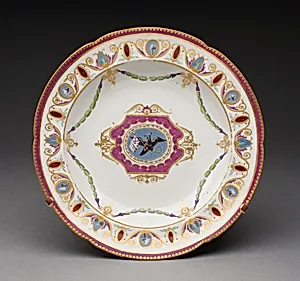
Soup Plate
Medium
Hard-paste porcelain, polychrome enamels, and gilding
Dimensions
Diam.: 24 cm (9 7/16 in.)
Classification
plate (general, dish)
Department
Applied Arts of Europe
Museum
Art Institute of Chicago
Accession Number
13707
Rights
Public Domain
Art Historical Context
This exquisite soup plate, produced by the Russian Imperial Porcelain Factory between 1762 and 1766, captures the grandeur of mid-18th-century Russian luxury crafts. Measuring 24 cm in diameter, it is fashioned from hard-paste porcelain—a prized material prized for its durability, translucency, and ability to withstand high kiln temperatures—decorated with vibrant polychrome enamels and shimmering gilding. These techniques allowed for intricate, colorful designs that mimicked the finest European porcelain traditions while showcasing Russian innovation. Founded in 1744 under Empress Elizabeth, the Imperial Porcelain Factory in St. Petersburg quickly became a symbol of tsarist prestige, supplying tableware and objets d'art for the royal court. By the 1760s, during Catherine the Great's early reign, pieces like this exemplified Russia's rise as a porcelain powerhouse, rivaling German and French makers like Meissen and Sèvres. The factory's mastery of hard-paste production, achieved through closely guarded secrets, marked a technical triumph for the empire. Housed in the Art Institute of Chicago's Department of Applied Arts of Europe, this plate highlights the cultural role of porcelain in diplomatic gifts and elite dining, blending functionality with opulent artistry. Visitors can admire how its gilded edges and enamel hues evoke the lavish rococo tastes of the era, inviting a taste of imperial elegance.