
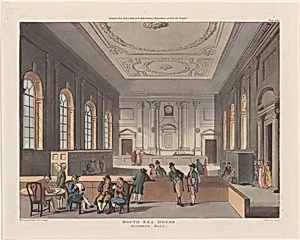
South Sea House, Dividend Hall
Medium
Hand-colored etching and aquatint
Dimensions
Sheet: 9 7/16 × 9 1/2 in. (23.9 × 24.1 cm) Plate: 8 7/8 × 11 3/16 in. (22.6 × 28.4 cm)
Classification
Prints
Department
Drawings and Prints
Museum
Metropolitan Museum of Art, New York, NY
Credit
The Elisha Whittelsey Collection, The Elisha Whittelsey Fund, 1959
Accession Number
59.533.1671(64)
Rights
Public Domain
Tags
Art Historical Context
Step into the opulent Dividend Hall of South House, as captured in this vibrant 1810 hand-colored etching andatint from *Ackermann's Microcosm of London*. Created by a stellar team—architectural draftsman Auguste Charles Pugin,aturist Thomas Rowlandson,atint specialist Thomas Sutherland and publisher Rudolph Ackermann print depicts the grand interior where shareholders once eagerly awaited dividends from the South Sea Company. Though the infamous 1720 South Sea Bubble financial scandal had long faded, the hall's neoclassical splendor, with its high vaulted ceiling, ornate columns, and bustling crowd of men and women, evokes London's enduring fascination with commerce and spectacle. The medium shines here: etching provides crisp lines for architectural details, while aquatint adds rich, watercolor-like tones, hand-colored for lifelike warmth. This collaborative technique, pioneered in Ackermann's series, blended Pugin's precise topography with Rowlandson's lively figures, making complex interiors accessible and entertaining. Published on February 1, 1810, it offers a window into Regency-era London, celebrating the city's public spaces amid economic recovery. Today, at the Metropolitan Museum of Art, this print (9 7/16 × 9 1/2 in.) highlights printmaking's role in documenting urban life, inviting us to ponder the human drama behind historic facades.