
Souvenir de Bretagne
1895
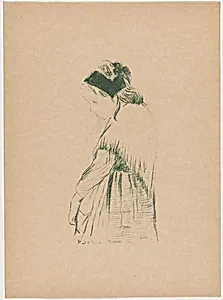
Medium
lithograph in green on heavy japan paper
Classification
Department
CG-E
Museum
National Gallery of Art, Washington, D.C.
Credit
Virginia and Ira Jackson Collection, gift in memory of Virginia H. Jackson
Accession Number
1996.151.165
Rights
Public Domain
Art Historical Context
**Souvenir de Bretagne** (1895) is a evocative lithograph by Paul Sérusier, a pioneering French artist associated with the Nabis group and the Pont-Aven School. Created during the height of Post-Impressionism, this print captures Sérusier's deep affection for Brittany, a rugged coastal region in northwestern France that profoundly influenced his work. As a "souvenir," it likely evokes nostalgic scenes of Breton landscapes or daily life, reflecting the Symbolist tendencies of the Nabis, who prioritized emotional resonance and decorative patterns over realistic depiction. Rendered in a striking single color of green on heavy Japan paper—a luxurious, textured Oriental import favored for fine prints—this lithograph showcases Sérusier's mastery of the medium. Lithography allowed for subtle tonal gradations and fluid lines, enabling affordable yet artistic multiples that democratized avant-garde imagery in the 1890s. The monochromatic green palette may evoke Brittany's lush foliage and misty seascapes, aligning with the Nabis' innovative use of color as mood rather than mimicry. Housed in the National Gallery of Art's CG-E Department as part of the Virginia and Ira Jackson Collection (gift in memory of Virginia H. Jackson), this print exemplifies late 19th-century printmaking's cultural bridge between elite painting and public appreciation. Visitors will appreciate its intimate scale and atmospheric depth, a testament to Sérusier's role in modernizing French art.
About the Artist
Paul Sérusier · 1864–1927
The painter first studied at the Lycée Condorcet in Paris, focusing on philosophy, then painting at the Académie Julian from 1885-1890. His painting of a Breton Weaver won an honorable mention at the Salon of 1888. He was the principal figure in the formation of the group known as the Nabis, in the same year. In 1896 he collaborated on masks and sets for the first performance of Alfred Jarry’s Ubu...