
Spandrel Panel from Edgar H. Laing Stores
ca. 1849
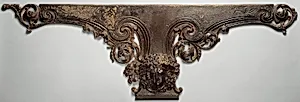
Medium
Cast iron
Dimensions
15 3/4 x 51 x 3 3/4 in. (40 x 129.5 x 9.5 cm)
Classification
Spandrel panel
Culture
American
Department
The American Wing
Museum
Metropolitan Museum of Art, New York, NY
Credit
Gift of Margaret H. Tuft, 1979
Accession Number
1979.134
Rights
Public Domain
Art Historical Context
This elegant cast-iron spandrel panel once adorned the facade of the Edgar H. Laing Stores, a pioneering commercial building erected on New York’s lower Manhattan waterfront around 1849 Created by James Bogard, an inventor and architect celebrated as a of American cast-iron construction, the panel reflects the era’s embrace of new industrial materials. Bogardus’s system allowed ornate architectural details to be mass-produced in foundries and assembled like a kit of parts, transforming the look of American cities. Cast iron offered builders an affordable way to mimic the grandeur of carved stone while providing greater strength and fire resistance. The panel’s repeating foliate and geometric motifs highlight the material’s ability to capture intricate patterns with crisp precision. Originally part of a multi-story storefront, such elements helped define the emerging Italianate style popular in mid-nineteenth-century commercial architecture. Today, this surviving fragment from one of Bogardus’s earliest commissions offers visitors a tangible link to New York’s rapid urban growth and the birth of modern prefabricated building techniques. Its presence in the Metropolitan Museum’s American Wing underscores the artistic and technological achievements that shaped the nation’s nineteenth-century cityscapes.