
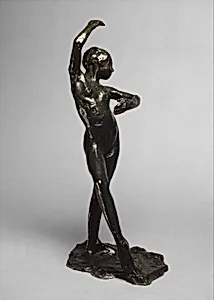
Spanish Dancer (Second State)
modeled probably ca. 1884, cast 1920
Medium
Bronze
Dimensions
17 x 8-3/8 x 6 in. (43.2 x 21.3 x 15.2 cm.)
Classification
Sculpture-Bronze
Culture
French
Department
European Sculpture and Decorative Arts
Museum
Metropolitan Museum of Art, New York, NY
Credit
H.O. Havemeyer Collection, Bequest of Mrs. H.O. Havemeyer, 1929
Accession Number
29.100.395
Rights
Public Domain
Tags
Art Historical Context
Edgar Degas, the renowned French Impressionist, masterfully captured the grace and energy of dancers in his works, and *Spanish Dancer (Second State exemplifies this obsession. Modeled around 1884, this bronze depicts a female nude in a dynamic, twisting pose evocative of ballet or flamenco-inspired movement. Standing at 17 inches tall, it showcases Degas' fascination with the female form in motion, freezing a fleeting moment of performance in three dimensions—a departure from his more famous pastels and paintings. Cast in 1920 by the foundry A.-A. Hébrard et Cie from Degas' original wax models (many produced late in his life as his eyesight failed), this "second state" edition highlights the posthumous bronze editions that preserved his innovative sculptures. Bronze's durability allowed these intimate studies to endure, transforming ephemeral waxes into lasting icons of modern sculpture. Degas' realistic yet impressionistic style emphasized anatomy, balance, and the dancer's world behind the curtain. Acquired through the H.O. Havemeyer Collection and now in the Metropolitan Museum of Art's European Sculpture and Decorative Arts department, *Spanish Dancer* invites visitors to ponder the artistry of everyday performers. It reflects late 19th-century Parisian fascination with ballet culture, blending sensuality and athleticism in a timeless celebration of the human body.
About the Artist
Edgar Degas|A.-A. Hébrard et Cie · 1834–1917
Edgar Degas (1834-1917) stands as one of the most innovative artists of the nineteenth century, whose distinctive vision transformed how modern life could be depicted on canvas. Born Hilaire-Germain-Edgar De Gas in Paris to a wealthy banking family—his father French, his mother a Louisiana Creole from New Orleans—Degas received a classical education before abandoning law studies in 1855 to pursue ...