
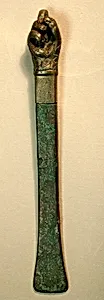
Spatula with fist finial
Unknown Artist
2nd–6th century
Medium
Copper, arsenical copper
Dimensions
H. 5 1/8 in.
Classification
Metal-Implements
Culture
Moche
Department
Arts of Africa, Oceania, and the Americas
Museum
Metropolitan Museum of Art, New York, NY
Credit
Purchase, Arthur M. Bullowa Bequest, 2001
Accession Number
2001.50
Rights
Public Domain
Art Historical Context
This exquisite spatula with fist finial, crafted by an unknown Moche artist between the 2nd and 6th centuries, hails from the ancient Moche culture of Peru's northern coast. Standing just 5 1/8 inches tall, this metal implement exemplifies the Moche's mastery of pre-Columbian metallurgy. Made from copper alloyed with arsenic—a technique that enhanced hardness and durability without iron—it reflects early Andean innovations in smelting and casting, allowing for finely detailed tools that blended utility with symbolism. The fist-shaped finial at the handle's end likely carried ritual or symbolic weight, evoking themes of power, warfare, or protection central to Moche society. Spatulas like this were probably used in shamanic practices, such as preparing hallucinogenic snuff or mixing pigments for body paint, underscoring the culture's rich spiritual traditions. The Moche, renowned for their intricate ceramics and monumental adobe pyramids, produced such objects amid a thriving civilization focused on agriculture, trade, and elaborate ceremonies. Today, this artifact graces the Metropolitan Museum of Art's Arts of Africa, Oceania, and the Americas department, acquired through the Arthur M. Bullowa Bequest in 2001. It offers a tangible glimpse into Moche ingenuity, bridging everyday tools with profound cultural beliefs.