
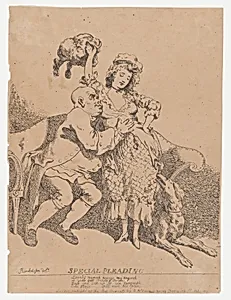
Special Pleading
[March 1780]
Medium
Etching
Dimensions
Sheet: 11 7/8 × 8 15/16 in. (30.2 × 22.7 cm)
Classification
Prints
Department
Drawings and Prints
Museum
Metropolitan Museum of Art, New York, NY
Credit
The Elisha Whittelsey Collection, The Elisha Whittelsey Fund and Harris Brisbane Dick Fund, by Exchange, 1970
Accession Number
1970.541.22
Rights
Public Domain
Tags
Art Historical Context
**Special Pleading**, a lively etching created by British caricaturist Thomas Rowlandson in collaboration with Alexander McKenzie in March1780, captures the satirical spirit of Georgian England. Measuring 11 7/8 × 8 15/16 inches, this print from the Metropolitan Museum Art's Drawings and Prints features men, women, and dogs in a humorous tableau. Rowlandson, renowned for his witty caricatures, often lampooned social follies, and the title plays on the legal term "special pleading"—a lawyer's artful argument—suggesting a courtroom farce or plea gone awry. Etching, Rowlandson's favored medium, involved incising lines into a copper plate with acid, enabling sharp details and mass production for affordable distribution to a wide audience. This technique amplified the reach of his biting commentary on professions, manners, and daily life during a turbulent era marked by the American Revolutionary War and social upheaval. Housed in The Elisha Whittelsey Collection, this work exemplifies Rowlandson's masterful blend of exaggeration and observation, inviting viewers to chuckle at human (and canine) quirks. A gem of 18th-century satire, it reminds us how art has long served as a mirror to society's absurdities. (198 words)
About the Artist
Thomas Rowlandson|Alexander McKenzie · 1756–1827
Thomas Rowlandson (1757–1827) was an English artist and caricaturist whose satirical watercolors and prints captured the social life of Georgian Britain with unparalleled wit and technical mastery. Alongside James Gillray, he is recognized as one of the greatest British graphic artists, and his distinctive flowing line and keen observations have made his work integral to understanding late 18th an...