
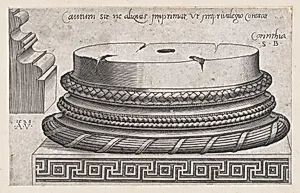
Speculum Romanae Magnificentiae: Corinthian base
Medium
Engraving
Dimensions
sheet: 4 9/16 x 7 5/16 in. (11.6 x 18.6 cm)
Classification
Prints
Department
Drawings and Prints
Museum
Metropolitan Museum of Art, New York, NY
Credit
Harris Brisbane Dick Fund, 1941
Accession Number
41.72(2.29)
Rights
Public Domain
Tags
Art Historical Context
Welcome to the Metropolitan Museum of Art's Drawings and Prints department, where we encounter *Speculum Romanae Magnificentiae Corinthian base*, a 1528 engraving by Agostinoiano (Agostino Musi). This intimate sheet, measuring just 4 9/16 x 7 5/16 inches, meticulously captures the ornate details of a Corinthian capital base from ancient Roman architecture—one of the most elaborate orders in classical design, known for its acanthus leaf motifs symbolizing natural abundance and imperial grandeur. Created during the Renaissance in Rome, Veneziano's print is part of the influential *Speculum Romanae Magnificentiae* ("Mirror of Roman Magnificence"), a groundbreaking series that documented the Eternal City's ruins through precise engravings. As a leading engraver who collaborated with masters like Marcantonio Raimondi, Veneziano employed fine-line techniques to reproduce architectural antiquities with astonishing fidelity, making them accessible beyond Italy. This medium revolutionized art and scholarship, allowing architects, artists, and collectors to study and revive classical forms amid the era's fervent rediscovery of antiquity. Thanks to the Harris Brisbane Dick Fund of 1941, this work highlights engraving's role in cultural transmission—bridging ancient Rome to the modern world and inspiring movements like Mannerism and Neoclassicism. A true gem for architecture enthusiasts!