
Speke Shore
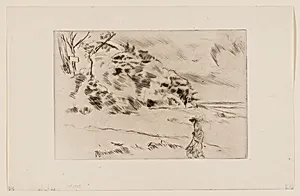
Medium
Drypoint in black ink on off-white laid paper
Dimensions
Plate: 15.2 × 22.8 cm (6 × 9 in.); Sheet: 21.7 × 33.8 cm (8 9/16 × 13 5/16 in.)
Classification
drypoint
Department
Prints and Drawings
Museum
Art Institute of Chicago
Accession Number
29630
Rights
Public Domain
Art Historical Context
James McNeill Whistler’s *Speke* (1875) captures the subtle beauty of the English coastline in a masterful drypoint print Executed in black ink on off-white laid paper, the plate measures 15.2 × 22.8 cm, with the full sheet at 21.7 × 33.8 cm. Housed in the Art Institute of Chicago’s Prints Drawings department, this work Whistler’s shift toward intimate, atmospheric landscapes during the 1870s, a period when he embraced printmaking as a primary medium alongside his renowned oil paintings. Whistler, an American expatriate in London and a key figure in the Aesthetic movement, prioritized “art for art’s sake,” focusing on tonal harmony and evocative mood over narrative detail. Drypoint, his chosen technique here, involves scratching directly into a metal plate with a sharp tool, raising a soft burr that holds ink to produce velvety, textured lines. This method allowed Whistler to render the misty shores of Speke—near Liverpool on the Mersey estuary—with delicate gradations, evoking tranquility and the play of light on water. As one of Whistler’s later drypoints, *Speke Shore* highlights his innovative printmaking, bridging etching traditions with impressionistic subtlety. Visitors will appreciate its technical finesse, a testament to why Whistler’s prints remain celebrated for their poetic restraint and enduring allure.
About the Artist
James McNeill Whistler · 1834–1903
James Abbott McNeill Whistler (1834-1903) was an American-born painter and printmaker who became a leading figure in the Aesthetic Movement and pioneer of Tonalism and Japonisme. He revolutionized art by championing "art for art's sake" and treating paintings as visual equivalents of musical compositions, titling works as "arrangements," "harmonies," and "nocturnes" to emphasize formal qualities o...