
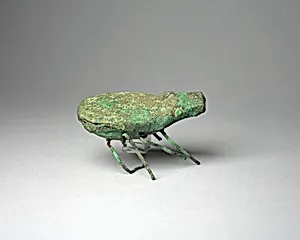
Spider
Unknown Artist
6th–7th century
Medium
Silvered copper, turquoise
Dimensions
H x W: 2 x 3 1/4in. (5.1 x 8.2cm)
Classification
Metal-Ornaments
Culture
Moche
Department
Arts of Africa, Oceania, and the Americas
Museum
Metropolitan Museum of Art, New York, NY
Credit
Bequest of Jane Costello Goldberg, from the Collection of Arnold I. Goldberg, 1986
Accession Number
1987.394.148
Rights
Public Domain
Tags
Art Historical Context
This delicate spider ornament, crafted by an unknown Moche artist between the 6th and 7th centuries, exemplifies the sophisticated metalworking of ancient Peru's north coast. Measuring just 2 x 3¼ inches (5.1 x 8.2 cm), it was fashioned from silvered copper with turquoise inlays, techniques that highlight the Moche's mastery of alloying and surface treatments to mimic precious metals. The insect form, rendered with precise detailing, likely served as personal adornment, such as a pendant or earspool, reflecting everyday or ritual use. The Moche culture (ca. 100–800 CE), renowned for their naturalistic depictions of animals and deities in ceramics and metals, infused such objects with symbolic power. Spiders, as agile weavers in Andean lore, may have evoked themes of creation or the underworld, though their exact meaning remains enigmatic. This piece's turquoise accents—sourced from distant regions—underscore extensive trade networks and elite craftsmanship. Now housed in the Metropolitan Museum of Art's Department of the Arts of Africa, Oceania, and the Americas, thanks to the 1986 bequest of Jane Costello Goldberg, it offers a window into Moche artistry's enduring allure. Visitors, imagine pinning this tiny marvel to your attire over a millennium ago!