
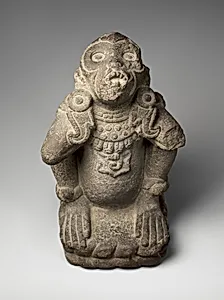
Spider Monkey with Wind God Regalia
Unknown Artist
13th–16th century
Medium
Stone
Dimensions
H. 15 9/16 × W. 9 1/2 × D. 10 in. (39.5 × 24.1 × 25.4 cm)
Classification
Stone-Sculpture
Culture
Aztec
Department
Arts of Africa, Oceania, and the Americas
Museum
Metropolitan Museum of Art, New York, NY
Credit
Gift of Brian and Florence Mahony, in celebration of the Museum's 150th Anniversary, 2017
Accession Number
2017.393
Rights
Public Domain
Art Historical Context
This striking stone sculpture, *Spider Monkey with Wind Godalia*, hails from Aztec culture during the 13th–16th centuries, a time when the Aztec empire dominated central Mexico with its sophisticated artistry and cosmology. Carved from stone to dimensions of 15 9/16 × 9 1/2 × 10 inches, the figure depicts a spider monkey adorned in the ceremonial attire of a wind deity, blending animal vitality with divine symbolism. Such hybrid forms were common in Aztec iconography, where animals often embodied gods or served as sacred intermediaries. The medium of stone underscores the Aztecs' mastery of hard-stone carving, a technique requiring immense skill to achieve the sculpture's compact, detailed proportions—ideal for temple altars or elite offerings. Monkeys held playful yet potent roles in Mesoamerican lore, sometimes linked to wind spirits that carried divine breath and fertility. This piece, gifted to the Metropolitan Museum of Art in 2017 for its 150th anniversary, exemplifies the Aztecs' reverence for nature's forces woven into religious life. Visitors will appreciate how this artifact captures the Aztecs' worldview: a universe alive with gods manifesting through everyday creatures, frozen in enduring stone.