
Spindle
Unknown Artist
2nd–7th century
Medium
Thorn, ceramic, thread
Dimensions
L. 30.0 cm
Classification
Textiles-Implements
Culture
Nasca
Department
Arts of Africa, Oceania, and the Americas
Museum
Metropolitan Museum of Art, New York, NY
Credit
Bequest of Jane Costello Goldberg, from the Collection of Arnold I. Goldberg, 1986
Accession Number
1987.394.702
Rights
Public Domain
Art Historical Context
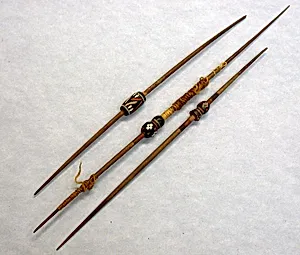
Nestled in the Metropolitan Museum of Art's Arts of Africa, Oceania, and the Americas department, this humble yet remarkable *Spindle* hails from the Nasca of ancient Peru, dating to the 2nd–7th century CE. Measuring 30 cm in length, it is crafted from thorn, ceramic, and thread—a practical tool ingeniously combining natural and fired materials. The Nasca, who thrived in the arid south coast of Peru from around 100 BCE to 800 CE, were masters of adaptation, channeling their environment into sophisticated crafts. As a textile implement, this spindle played a vital role in one of the Nasca's crowning achievements: their exquisite weaving traditions. Spindles like this were used to twist fibers—likely cotton or camelid wool—into strong threads, forming the foundation for vibrant tapestries, garments, and ritual cloths adorned with intricate motifs of animals, plants, and mythical beings. The ceramic elements, possibly a weighted whorl, enhanced spinning efficiency, showcasing the culture's technical prowess alongside their famed pottery and monumental geoglyphs. Bequeathed by Jane Costello Goldberg from the Collection of Arnold I. Goldberg in 1986, this artifact offers a glimpse into everyday Nasca ingenuity. Far from mere utility, it embodies a society where art and labor intertwined, preserving fibers that wove stories of their world. A testament to enduring craftsmanship!