
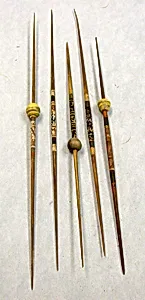
Spindle
Unknown Artist
10th–16th century (?)
Medium
Wood, paint
Dimensions
Height 10-1/8 in.
Classification
Textiles-Implements
Culture
Peruvian
Department
Arts of Africa, Oceania, and the Americas
Museum
Metropolitan Museum of Art, New York, NY
Credit
Bequest of Arthur M. Bullowa, 1993
Accession Number
1994.35.32
Rights
Public Domain
Art Historical Context
This delicate wooden spindle, hailing from ancient Peru and dating to the 10th–16th century, offers a glimpse into the everyday artistry of pre-Columbian Andean societies Standing just 10-1/8 inches tall, it was a vital tool in textile production—a craft central to Peruvian culture, where finely spun yarns wove intricate fabrics for clothing, rituals, and trade. Classified as a textiles implement, such spindles were used by spinners to twist fibers like cotton or alpaca wool into thread, reflecting the ingenuity of communities from the late Intermediate Period through the Inca era. Crafted from wood and adorned with paint, the spindle's modest decoration highlights the fusion of utility and aesthetics in Andean life. The applied pigments, now softened by time, likely added visual appeal during the spinning process, a task often performed by women in communal settings. Its survival speaks to the enduring value placed on these tools, preserved through bequest to the Metropolitan Museum of Art in 1993. Though the artist remains unknown, this artifact underscores Peru's textile legacy—one of the world's finest—where everyday objects embodied cultural identity and skill. Visitors, imagine the rhythmic whir of spindles echoing through highland villages, birthing masterpieces of fiber and color.