
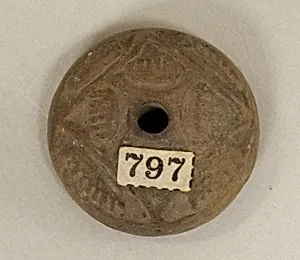
Spindle Whorl
Unknown Artist
10th–early 16th century
Medium
Ceramic
Dimensions
Diameter 1-3/16 in.
Classification
Ceramics-Implements
Culture
Mexican
Department
Arts of Africa, Oceania, and the Americas
Museum
Metropolitan Museum of Art, New York, NY
Credit
Museum Purchase, 1900
Accession Number
00.5.797
Rights
Public Domain
Art Historical Context
Nestled in the Metropolitan Museum of Art collection of Arts of Africa, Oceania and the Americas, this ceramic spindle whorl from Mexican culture dates to the 10th early 16th century—a span encompassing vibrant pre-Columbian societies like the Toltecs, Mixtecs, and Aztecs. Measuring just 1-3/16 in diameter, its modest size belies its practical ingenuity as a tool for spinning fibers into thread. Purchased by the museum in1900, it offers a tangible link to the daily lives ancient Mesoamericans. Spindle whorls were essential for textile production, a cornerstone of Mexican economies and rituals. Women, often the primary spinners, attached these weights to wooden spindles to provide momentum and tension, transforming raw cotton, agave, or wool into yarn for weaving garments, blankets, and ceremonial cloths. This whorl's ceramic medium highlights advanced pottery skills; likely wheel-thrown or molded and fired for durability, it reflects the fusion of utility and subtle artistry in everyday objects. Though created by an unknown artist, the whorl embodies the cultural reverence for craftsmanship in pre-Hispanic Mexico, where such implements were sometimes adorned with motifs symbolizing fertility or cosmology. A quiet testament to indigenous innovation, it invites us to appreciate the unsung labor behind the textiles that draped ancient elites and commoners alike.