
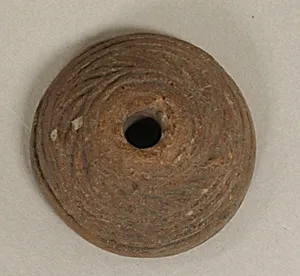
Spindle Whorl
Unknown Artist
10th–early 16th century
Medium
Ceramic
Dimensions
Diameter 1-1/10 in.
Classification
Ceramics-Implements
Culture
Mexican
Department
Arts of Africa, Oceania, and the Americas
Museum
Metropolitan Museum of Art, New York, NY
Credit
Museum Purchase, 1900
Accession Number
00.5.829
Rights
Public Domain
Art Historical Context
This petite ceramic spindle whorl, just over an inch in diameter, hails from ancient Mexico and dates to the 10 through early 16th century—a period encompassing vibrant Mesoamerican cultures like the Toltecs and early Aztecs. As a humble yet essential tool, it was attached to a spindle stick to add weight and spin, facilitating the transformation of raw fibers like cotton or agave into thread. Such implements were everyday necessities in households, underscoring the centrality of textile production in pre-Columbian societies. Crafted from clay and fired to durability, this spindle whorl exemplifies the sophisticated ceramic techniques of Mexican artisans, who molded small, functional objects with precision. While its exact decorative motifs remain unnoted, these tools often featured intricate incised patterns or symbolic motifs reflecting cultural beliefs in fertility, weaving deities, or cosmic cycles—women's work intertwined with spirituality. Acquired by the Metropolitan Museum of Art in 1900, this artifact bridges the practical and the profound, offering a tangible glimpse into the daily ingenuity of Mexico's indigenous peoples before European contact. It reminds us how even the smallest objects carry the weight of history.