
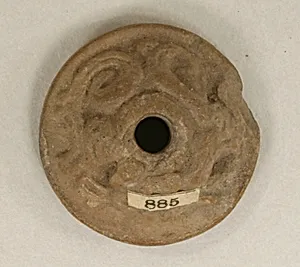
Spindle Whorl
Unknown Artist
10th–early 16th century
Medium
Ceramic
Dimensions
Diameter 1-1/16 in.
Classification
Ceramics-Implements
Culture
Mexican
Department
Arts of Africa, Oceania, and the Americas
Museum
Metropolitan Museum of Art, New York, NY
Credit
Museum Purchase, 1900
Accession Number
00.5.885
Rights
Public Domain
Art Historical Context
Nestled in the Metropolitan Museum of Art collection of Arts of Africa,, and the Americas, petite **Spindle Whorl**a ceramic disc just 1-1/16 inches in—hails from ancient Mexico, spanning the 10th to early 16th century.ed by an unknown artist, it exemplifies pre-Columbian ingenuity as a humble yet essential tool for spinning fibers into thread. Weighted at the end of a spindle, it provided the momentum needed to twist cotton, agave, or other plant fibers, transforming raw materials into yarn for weaving cloth. In Mexican indigenous cultures of the Postclassic period, such as those preceding the Aztec empire, textile production was a cornerstone of daily life, economy, and ritual. Women artisans, in particular, mastered these implements, producing fabrics for clothing, tribute, and trade. The ceramic medium, fired for durability, highlights practical craftsmanship: small enough to fit comfortably in the hand, yet robust for repetitive use. Its classification as a "Ceramics-Implement" underscores how everyday objects blended utility with subtle artistry. Purchased by the Museum in 1900, this whorl offers a tangible link to the vibrant world of pre-Hispanic Mexico, reminding us that beauty often thrived in the tools of labor. Imagine the rhythmic hum of spindles in bustling households— a testament to enduring cultural traditions. (198 words)