
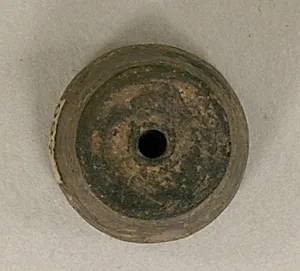
Spindle Whorl
Unknown Artist
10th–early 16th century
Medium
Ceramic
Dimensions
Diameter 19/32 in.
Classification
Ceramics-Implements
Culture
Mexican
Department
Arts of Africa, Oceania, and the Americas
Museum
Metropolitan Museum of Art, New York, NY
Credit
Museum Purchase, 1900
Accession Number
00.5.927
Rights
Public Domain
Art Historical Context
Nestled in the Metropolitan Museum of Art collection of Arts of Africa, Oceania, and the Americas, this ceramic spindle whorl from Mexican culture dates to the 10th early 16th century Measuring just 19/32 inches in diameter this unassuming disk served a vital practical purpose: it was attached to a spindle to add weight and spin fibers like cotton or agave into thread. Acquired by the museum through purchase in 1900 it exemplifies everyday implements that bridged utility and craftsmanship in pre-Columbian Mesoamerica. Spanning centuries from the Postclassic period into the era of early Spanish contact, the spindle whorl reflects the centrality of textile production in Mexican societies, where women often spun yarn for clothing, nets, and trade goods. Ceramics were a favored medium for such tools due to their durability and accessibility, molded and fired to create balanced, functional forms. Though created by an unknown artist, its survival highlights the skilled pottery traditions of regions like central Mexico, possibly linked to groups such as the Aztecs or their predecessors. Today, this tiny artifact invites us to appreciate the artistry in the ordinary—how ancient makers transformed clay into essential tools that sustained communities and economies. A testament to enduring cultural ingenuity!