
Spindle Whorl
Unknown Artist
10th–16th century (?)
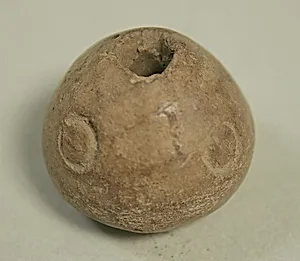
Medium
Ceramic
Dimensions
H> 3/4 × Diam. 1 1/8 in. (1.9 × 2.9 cm)
Classification
Ceramics-Implements
Culture
Peruvian
Department
Arts of Africa, Oceania, and the Americas
Museum
Metropolitan Museum of Art, New York, NY
Credit
Gift of Nathan Cummings, 1962
Accession Number
62.266.84
Rights
Public Domain
Art Historical Context
Nestled in the Metropolitan Museum of Art's collection of Arts of Africa, Oceania, and Americas, this modest ceramic spindle whorl hails from ancient Peru, dating to the 10th–16th century. Measuring just 3/4 inch high and 1 1/8 inches in diameter, this unassuming disk was a vital tool for spinning yarn—a spindle whorl spun at the end of a stick to twist fibers into thread, essential for creating the renowned textiles of pre-Columbian Andean societies. In Peruvian culture, textiles were more than fabric; they were woven narratives of identity, cosmology, and status, traded across vast networks from the coast to the highlands. Ceramics like this whorl highlight the technical prowess of ancient potters, who fired clay at high temperatures to achieve durability for everyday use. Though the artist remains unknown, the object's survival speaks to the ingenuity of these communities during a dynamic era bridging the Middle Horizon to the Late Intermediate Period, just before Inca dominance. Gifted to the Met in 1962 by Nathan Cummings, this spindle whorl invites us to appreciate the artistry in utility—reminding visitors that even small implements carried profound cultural weight in the fiber-rich world of ancient Peru.