
Spindle whorl
Unknown Artist
ca. 2900–2600 BCE
Medium
Ceramic
Dimensions
0.63 in. (1.6 cm)
Classification
Ceramics-Implements
Culture & Period
Sumerian · Early Dynastic I-II
Department
Ancient Near Eastern Art
Museum
Metropolitan Museum of Art, New York, NY
Credit
Rogers Fund, 1962
Accession Number
62.70.89
Rights
Public Domain
Art Historical Context
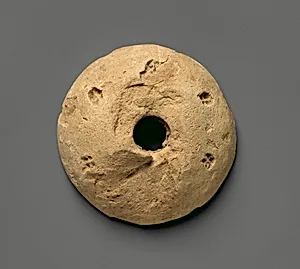
This petite ceramic spindle whorl, dating to around 2900–2600 BCE, offers a glimpse into the daily ingenuity of Sumerian life during the Early Dynastic I periods in ancient Mesopotamia. Measuring just 0.63 (1.6 cm) in diameter, it served as a vital tool for spinning thread: attached to a wooden spindle, its weight helped plant fibers or wool into yarn, a foundational craft for textiles essential to clothing, trade, and even sails for early boats. Crafted from fired clay—a common and durable medium in Sumerian ceramics—this implement reflects the period's advancements in pottery techniques, where everyday objects blended utility with subtle artistry. Sumer, the cradle of urban civilization with pioneering city-states like Uruk and Ur, relied on such tools for household economies, often managed by women. Its survival underscores the resilience of these modest artifacts amid monumental achievements like cuneiform writing and ziggurats. Now housed in the Metropolitan Museum of Art's Ancient Near Eastern Art Department (acquired via the Rogers Fund in 1962), this spindle whorl reminds us that ancient innovation thrived in the hands of ordinary people, weaving the fabric of one of humanity's earliest complex societies.