
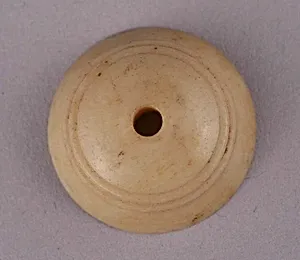
Spindle Whorl
Unknown Artist
9th–10th century
Medium
Bone; incised
Dimensions
H. 5/16 in. (0.8 cm) Diam. 11/16 in. (1.8 cm)
Classification
Ivories and Bone
Department
Islamic Art
Museum
Metropolitan Museum of Art, New York, NY
Credit
Rogers Fund, 1940
Accession Number
40.170.332
Rights
Public Domain
Art Historical Context
Nestled in the Metropolitan Museum of Art Islamic Art collection, this delicate spindle whorl from the 9th–10th century exemplifies the everyday artistry of the early Islamic world. Crafted bone and meticulously incised—meaning fine lines and patterns were engraved into its surface—this tiny disc, just 11/16 inches (1.8 cm) in diameter and 5/16 inch (0.8 cm) high, served a practical purpose: weighting a spindle to spin wool or other fibers into thread. Such tools were essential households across the Abbasidiphate and beyond, utility with subtle decoration. The incising technique highlights the skilled craftsmanship of anonymous artisans, who transformed humble bone—often from animals like camels or sheep—into objects of quiet beauty. These whorls were pierced centrally for the spindle, and their engraved motifs, though worn by time, likely included geometric patterns or floral motifs common in Islamic design, reflecting a cultural reverence for harmony and repetition. Acquired through the Rogers Fund in 1940, this spindle whorl offers a window into daily life during Islam's Golden Age, reminding us that art thrived not only in grand mosques but in the hands of ordinary people, preserving threads of history—literally and figuratively.