
Spinet
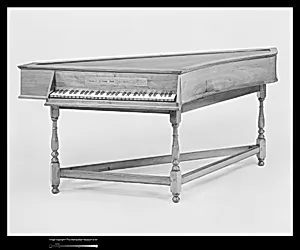
Medium
Walnut, maple, yellow pine, Atlantic white cedar
Dimensions
33 1/2 x 73 1/4 x 27 in. (85.1 x 186.1 x 68.6 cm)
Classification
Spinet
Culture
American
Department
The American Wing
Museum
Metropolitan Museum of Art, New York, NY
Credit
Rogers Fund, 1944
Accession Number
44.149a, b
Rights
Public Domain
Art Historical Context
This elegant spinet, crafted in 1739 by Johannes Gottlob Clemm, represents one of the earliest surviving keyboard instruments made in colonial America. As a compact member of the harpsichord family, the spinet produces sound by plucking strings with quills, offering a delicate tone suited to intimate domestic settings. Its presence in the Metropolitan Museum’s American Wing highlights the growing musical culture among prosperous colonists in the mid-eighteenth century, when European musical traditions began taking root in the New World. Clemm, a German-born instrument maker who settled in Pennsylvania, combined European design principles with locally available materials. The instrument’s case features richly grained walnut and maple, accented by structural elements of yellow pine and Atlantic white cedar, demonstrating both aesthetic refinement and practical adaptation to American resources. Measuring just over six feet in length, its modest scale made it ideal for parlors and small music rooms. Acquired by the museum in 1944 through the Rogers Fund, this spinet offers visitors a tangible connection to early American craftsmanship and the role of music in colonial life. Its survival provides valuable insight into the technical skill of colonial artisans who helped establish a distinctly American tradition of instrument making.