
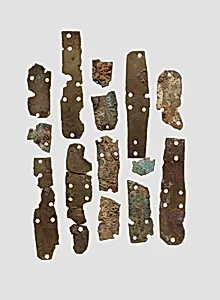
Splint armor
Unknown Artist
ca. 3rd–7th century CE
Medium
Iron, bronze
Dimensions
5 1/8 in. (13 cm)
Classification
Metalwork-Implements
Culture & Period
Sasanian · Sasanian
Department
Ancient Near Eastern Art
Museum
Metropolitan Museum of Art, New York, NY
Credit
Rogers Fund, 1936
Accession Number
36.30.295
Rights
Public Domain
Art Historical Context
This exquisite splint armor fragment, dating to the Sasanian (ca. 3rd–7th century CE), offers a rare glimpse into the military ingenuity of ancient Persia. Crafted from iron and bronze by an unknown artisan, this 5 1/8-inch (13 cm) piece exemplifies Sasanian metalwork, thin metal splints were likely riveted or laced together to form flexible protective gear for warriors. On view in the Metropolitan Museum of Art's Ancient Eastern Art department (Rogers Fund, 1936), it highlights the empire's advanced metallurgy, blending durability with mobility for cavalry forces. The Sasanians, who ruled from 224–651 CE, were formidable rivals to the Roman and Byzantine empires, and their armor reflected a sophisticated approach to warfare. Iron provided robust defense against blades and arrows, while bronze added corrosion resistance and decorative potential. This technique influenced later Islamic and Central Asian armors, underscoring the cultural exchange across Eurasia. Though small, this artifact evokes the thunder of Sasanian cataphracts—elite armored horsemen—charging into battle, reminding us how everyday metalwork shaped empires. A testament to anonymous craftsmanship, it invites us to ponder the lives of those who forged protection amid conquest.