
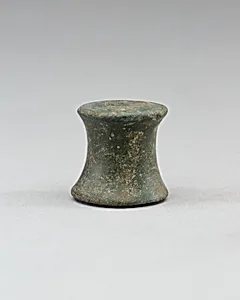
Spool-Shaped Game Pieces from Neferkhawet's Tomb
Unknown Artist
ca. 1504–1447 B.C.
Medium
Faience
Dimensions
H. 1.9 cm (3/4 in.); Diam. 1.8 cm (11/16 in.)
Classification
Game piece, spool, burial 8
Period
New Kingdom
Department
Egyptian Art
Museum
Metropolitan Museum of Art, New York, NY
Credit
Rogers Fund, 1935
Accession Number
35.3.16
Rights
Public Domain
Tags
Art Historical Context
These delicate spool-shaped game pieces, from the tomb of Neferkhawet—a high-ranking official's wife during Egypt's New Kingdom (ca. 1504–1447 B.C.)—offer a glimpse into the leisurely pastimes of ancient elites. Dating to the early 18th Dynasty, they were likely placed in the tomb to provide entertainment in the afterlife, reflecting the Egyptians' belief in a vibrant posthumous existence filled with familiar joys. Crafted from faience—a brilliant, turquoise-glazed composite of quartz and clay frit that mimicked precious lapis lazuli—these tiny objects measure just 1.9 cm high and 1.8 cm in diameter. Faience was prized for its vibrant color and affordability, allowing widespread use in amulets, tiles, and games. The spool shape, with its smooth, ergonomic form, suggests they were counters for popular board games like senet, a strategic pastime symbolizing the soul's journey through the underworld. Acquired by the Metropolitan Museum of Art through the Rogers Fund in 1935, these pieces highlight the artistry of anonymous Egyptian craftsmen. They remind us that even in death, the ancient Egyptians valued play, blending craftsmanship with profound spiritual symbolism.