
Spoon
Unknown Artist
possibly 18th century
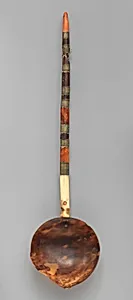
Medium
Tortoiseshell, coral, brass, amber, and bone
Dimensions
Length: 10 in. (25.4 cm)
Classification
Natural Substances
Culture
possibly Italian
Department
European Sculpture and Decorative Arts
Museum
Metropolitan Museum of Art, New York, NY
Credit
Gift of Mrs. Samuel P. Avery, 1897
Accession Number
97.2.155
Rights
Public Domain
Art Historical Context
This exquisite spoon, possibly crafted in 18th-century Italy, exemplifies the opulent decorative arts of Europe during the Rococo era. Measuring 10 inches in length, it showcases masterful craftsmanship through an array of luxurious natural materials: tortoises for its glossy, iridescent sheen; vibrant coral for ornamental accents; warm amber and bone for carved details; and brass for subtle metallic highlights. Such combinations highlight the era's fascination with exotic substances sourced from distant seas and lands, transforming a utilitarian object into a work of art. Housed in the Metropolitan Museum of Art's Department of European Sculpture and Decorative Arts and classified under Natural Substances, the spoon reflects the technical virtuosity of anonymous artisans who inlaid and polished these diverse elements. Tortoiseshell, heated and molded for intricate patterns, was a prized medium for luxury goods, while coral—harvested from Mediterranean waters—added a jewel-like allure symbolizing vitality and prestige. These techniques underscore Italy's role as a hub for finely wrought household items, often used in elite dining or ceremonial contexts. A generous gift from Mrs. Samuel P. Avery in 1897, this piece invites visitors to ponder the hidden artistry in everyday forms, bridging the natural world with human ingenuity.