
Spoon
Unknown Artist
18th century
Medium
Pewter
Dimensions
7 × 2 1/2 in. (17.8 × 6.4 cm)
Classification
Metalwork-Pewter
Culture
Flemish
Department
European Sculpture and Decorative Arts
Museum
Metropolitan Museum of Art, New York, NY
Credit
Rogers Fund, 1906
Accession Number
06.854
Rights
Public Domain
Art Historical Context
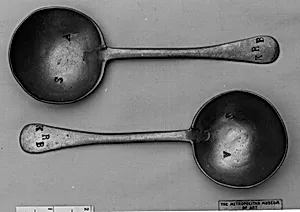
This elegant 18th-century Flemishter spoon, measuring a modest 7 × 2½ inches, exemplifies the refined metalwork traditions of Flanders, a region renowned for its skilled craftsmanship in decorative arts. Produced during an era when Europe's burgeoning middle class sought affordable yet sophisticated tableware, this piece from the Unknown Artist reflects the everyday elegance of Flemish domestic life. Housed in the Metropolitan of Art's Department of Sculpture and Decorative Arts, it was acquired through the Rogers Fund in 6, highlighting its value as a preserved artifact of cultural heritage. Pewter, an alloy primarily of tin with traces of other metals, was prized for its malleability, luster, and durability—qualities that made it a practical silver substitute for households across Europe. Flemish pewterers excelled in shaping such wares with precise hammering and casting techniques, often incorporating subtle engravings or molded handles that balanced form and function. Though the specific design details of this spoon remain understated, its survival underscores the artistry in utilitarian objects, bridging the gap between craft and fine art. Today, this spoon invites us to appreciate the unsung makers of the 18th century, whose work adorned tabletops and told stories of trade, innovation, and taste in the Low Countries. A small treasure, it reminds museum visitors of how ordinary items can embody extraordinary historical depth.