
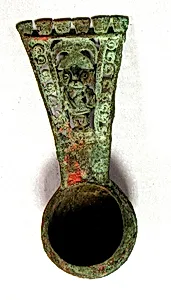
Spoon
Unknown Artist
12th–15th century
Medium
Copper (cast)
Dimensions
Height 4-1/2 in. (11.4 cm)
Classification
Metal-Implements
Culture
Chimú
Department
Arts of Africa, Oceania, and the Americas
Museum
Metropolitan Museum of Art, New York, NY
Credit
Bequest of Jane Costello Goldberg, from the Collection of Arnold I. Goldberg, 1986
Accession Number
1987.394.413
Rights
Public Domain
Art Historical Context
This elegant copper spoon, crafted by an unknown Chimú artist between the 12th and 15th centuries, offers a glimpse into the sophisticated metalworking traditions of ancient Peru's north coast. The Chimú culture, flourishing during Peru's Late Intermediate Period, built the vast adobe city of Chan Chan and excelled in metallurgy, producing intricate objects that blended utility with artistry. Standing at just 4-1/2 inches tall, this implement exemplifies their mastery of casting techniques, likely using the lost-wax method to create a seamless, durable form from copper—a metal abundant in the region and valued for its workability. The spoon's classification as a metal implement highlights the Chimú's practical innovations; such tools were essential for serving food, liquids, or ritual substances in both domestic and ceremonial contexts. Copper casting allowed for precise detailing and mass production, reflecting a society where artisans served powerful elites. Though simple in design, its survival speaks to the enduring quality of Chimú craftsmanship, now preserved through the bequest of Jane Costello Goldberg at The Metropolitan Museum of Art. Visitors to our virtual museum can appreciate how this unassuming spoon bridges everyday life and cultural prestige, underscoring the Chimú's legacy before their conquest by the Inca in the late 15th century.