
Spoon
Unknown Artist
7th–2nd century BCE
Medium
Stone
Dimensions
Length 2-1/4 in.
Classification
Stone-Implements
Culture
Chavin (?)
Department
Arts of Africa, Oceania, and the Americas
Museum
Metropolitan Museum of Art, New York, NY
Credit
Purchase, Anonymous Gift, 1993
Accession Number
1993.458.1
Rights
Public Domain
Art Historical Context
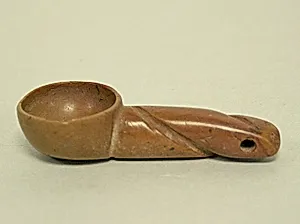
This delicate stone spoon, dating to the 7th–2nd century BCE, hails from the ancient Chavin culture—or is tentatively attributed to it—in the Andean region of South America. Measuring just 2-1/4 inches in length, its compact form speaks to the ingenuity of early pre-Columbian artisans who crafted everyday tools from durable stone. Acquired by the Metropolitan Museum of Art through an anonymous gift in 1993, it now resides in the Department of Arts of Africa, Oceania, and the Americas, classified as a stone implement. Chavin society, flourishing during Peru's Early Horizon period, marked a pivotal moment in Andean history with the rise of complex religious centers and monumental architecture. Stone carving was a hallmark technique, often blending utilitarian function with symbolic potential—spoons like this might have served in rituals, food preparation, or elite feasting, reflecting social hierarchies. The object's smooth, ergonomic design highlights masterful stoneworking skills, achieved without metal tools, underscoring the culture's technological prowess. Though its exact use remains a mystery, this spoon offers a tangible link to Chavin life's rhythms, inviting us to ponder how such humble artifacts bridged the mundane and the sacred in one of the Americas' earliest civilizations.