
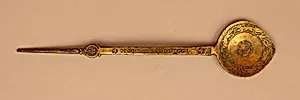
Spoon
Unknown Artist
12th–13th century
Medium
Brass; cast and engraved
Dimensions
H. 8 1/2 in. (21.6 cm) Diam. 1 7/8 in. (4.7 cm)
Classification
Metal
Department
Islamic Art
Museum
Metropolitan Museum of Art, New York, NY
Credit
Purchase, Rogers Fund and Margaret Mushekian Gift, 1978
Accession Number
1978.378
Rights
Public Domain
Art Historical Context
This elegant brass spoon, crafted in the 12th–13th century, exemplifies masterful metalworking traditions of the Islamic world. Standing at 8½ inches tall with a bowl diameter of 1⅞ inches, it was created through casting—pouring molten brass into mold for the basic form—and intricate engraving, a technique that allowed artisans to incise fine decorative patterns directly into the metal surface. Such methods were hallmarks of Islamic craftsmanship during the medieval period, transforming everyday utensils into objects of beauty and utility. Housed in the Metropolitan Museum of Art's Islamic Art Department, this spoon reflects the flourishing metalwork industry across regions like the eastern Mediterranean, Iran, and Central Asia under Abbasid and Seljuk influences. Brass, an alloy of copper and zinc, was prized for its durability, golden hue, and workability, making it ideal for household items that blurred the line between function and art. Though the artist remains unknown, the spoon's survival highlights the cultural value placed on refined domestic objects. Acquired through the Rogers Fund and a generous gift in 1978, it invites visitors to ponder the daily lives of medieval Islamic societies, where even a simple spoon could showcase technical virtuosity and aesthetic sensibility.