
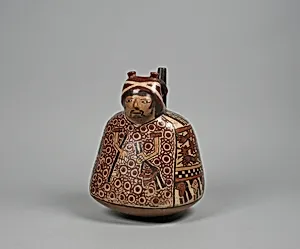
Spout-and-bridge bottle with warrior
400–600 CE
Medium
Ceramic, slip
Dimensions
H. 9 1/4 × W. 7 1/8 in. (23.5 × 18.1 cm)
Classification
Ceramics-Containers
Culture
Nasca
Department
Arts of Africa, Oceania, and the Americas
Museum
Metropolitan Museum of Art, New York, NY
Credit
Gift of Mr. and Mrs. Nathan Cummings, 1964
Accession Number
64.228.66
Rights
Public Domain
Tags
Art Historical Context
This elegant spout-and-bridge was created by Nasca artists 400 and 600. The Nasca culture of Peru’s southern coast produced some of the most refined ceramics in the ancient Andes. This distinctive vessel form—two spouts joined by a bridge handle—served both practical and ceremonial purposes, likely holding liquids for daily use or ritual offerings. Fashioned from ceramic and decorated with colored slip, it exemplifies the Nasca mastery of potting and painting techniques that allowed for durable, vibrant surfaces. The bottle features a warrior figure, a recurring motif that speaks to themes of conflict, ritual, and social identity in Nasca society. Nasca potters were renowned for their polychrome designs, applying multiple hues of slip to depict humans, animals, and mythical beings with remarkable precision. Such imagery often reflected the community’s complex worldview, including warfare and ceremonial practices. Now in the Metropolitan Museum of Art, this piece was a 1964 gift from Mr. and Mrs. Nathan Cummings. It offers visitors a tangible connection to Nasca artistic achievement and the rich cultural life of this ancient Andean civilization.